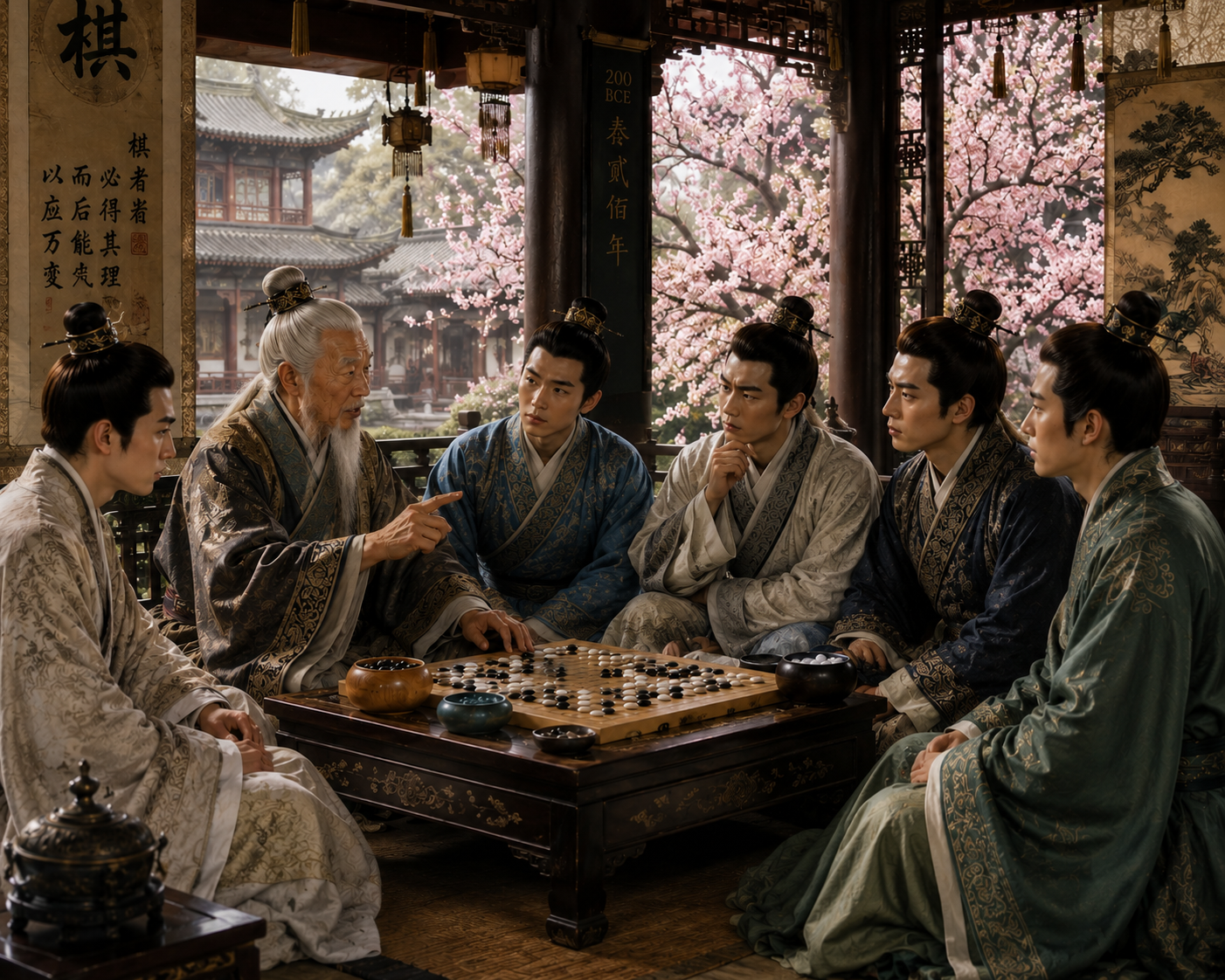
Ancient Origins in China
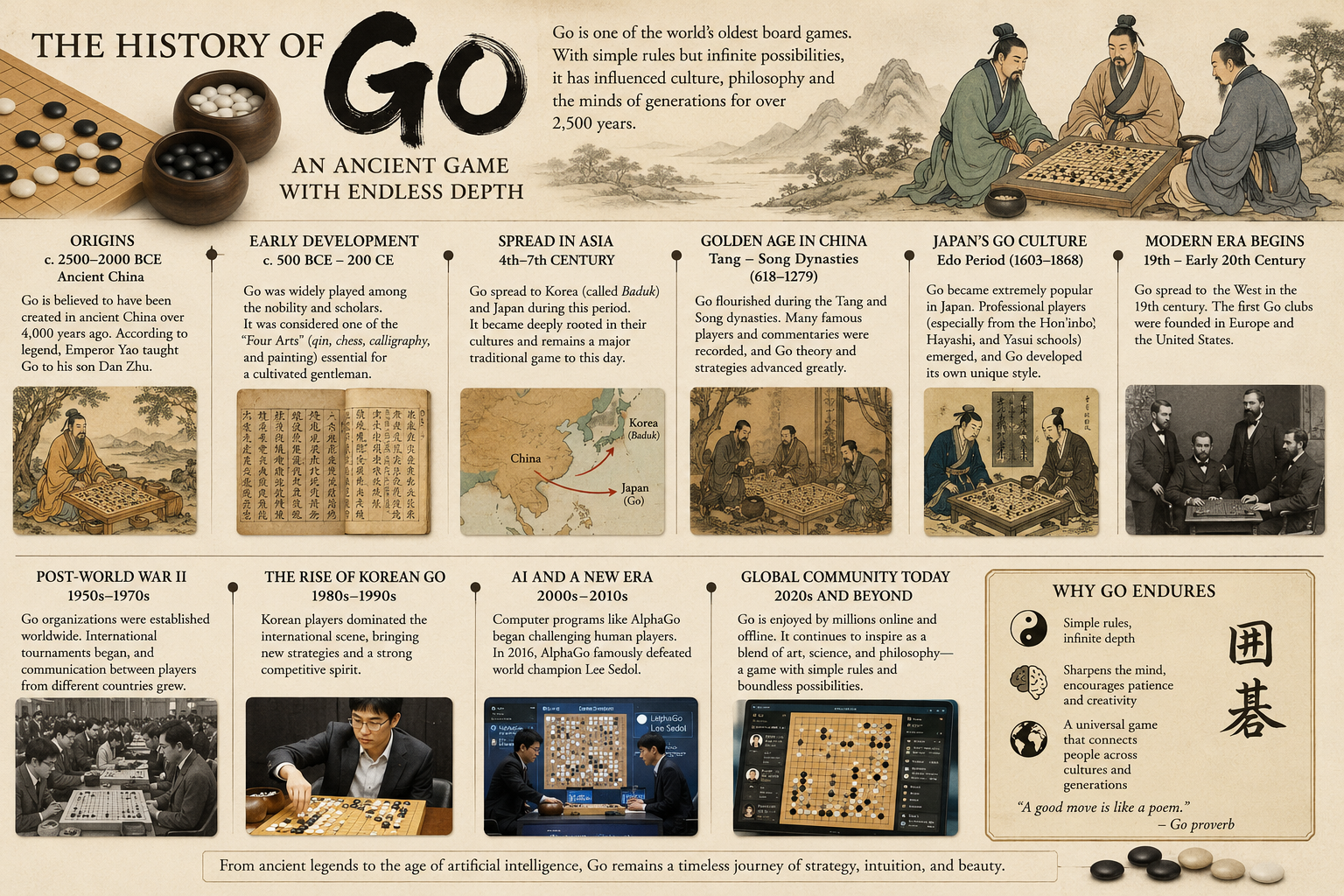
Go is one of the oldest board games still played in its original form. Most historians trace its beginnings to ancient China more than 2,500 years ago, where it was known as Weiqi. Early legends claim the game was used to teach discipline, patience, and long-term planning to young nobles. Even if those stories are partly symbolic, they capture the role Go quickly earned: a serious exercise in judgment rather than a simple pastime.
By the Han and Tang dynasties, Go had become part of elite culture. It was grouped with calligraphy, painting, and music as one of the refined arts expected of educated scholars. The rules remained elegantly minimal: place stones, surround territory, and balance local fights against global shape. That simple framework created strategic depth unmatched by most games of the era.
Expansion to Korea and Japan
From China, the game spread across East Asia, becoming Baduk in Korea and Igo in Japan. Each region built strong traditions while preserving the same core principles. Korea developed a particularly active competitive culture, while Japan invested deeply in formal study and institutions. By the medieval and early modern periods, Go was no longer only a scholar's activity; it had become a respected strategic discipline.
In Japan, state support during the Edo period helped create professional Go schools. Rival houses trained players for decades, developed opening theory, and recorded famous matches in detail. This period produced many foundational ideas still taught today, including principles of balance, influence, and life-and-death reading. The professionalization of Go in Japan had a long-lasting impact on how high-level play is studied around the world.
Modern Competition and Global Growth
In the 20th century, newspapers, federations, and international tournaments brought Go to much wider audiences. Japan, Korea, and China all hosted major title systems, while Europe, North America, and Australia established national associations and teaching communities. Books, clubs, and later internet servers made serious practice available far beyond East Asia.
As Go globalized, styles mixed. Tactical Korean fighting, Japanese precision, and Chinese influence- based strategy informed players everywhere. A game once associated with regional tradition became a worldwide language of strategy. Today, amateur and professional events attract participants from nearly every continent, and online play connects learners of every level in seconds.
The AI Turning Point
For decades, Go was considered one of the hardest classic games for computers because brute-force search alone was not enough. That changed dramatically in 2016, when AlphaGo defeated top professional Lee Sedol in a historic match. The series proved that machine learning and neural networks could master a domain long viewed as uniquely human in its need for intuition and pattern judgment.
The impact was immediate. Professionals began using AI analysis as a daily training tool, and opening theory changed at high speed. Moves once considered strange were validated, while old assumptions were revised. Rather than replacing human play, AI expanded it: players discovered fresh strategic ideas and a deeper understanding of efficiency, timing, and shape.
Why Go Endures
Go survives because it offers both clarity and mystery. The rules can be learned quickly, yet a full game rewards decades of improvement. Every move asks a fundamental question: should you secure what you have, invade what your opponent claims, or build influence for a future attack? The balance between local tactics and global planning gives Go a timeless intellectual appeal.
From ancient courts to smartphone apps, Go has adapted without losing its identity. It remains a game where creativity matters, patience is tested, and mistakes become lessons. Across cultures and centuries, its black and white stones continue to tell one of the richest stories in the history of strategy.