Grid Combat Before the Digital Era
Long before personal computers, children and students across Eastern Europe played many hidden-information grid games with pencil and paper, and Planes emerged from this broader culture of improvised strategy play. By the mid-20th century, classroom and break-time game traditions had already normalized square-grid coordinates, turn-based guessing, and symbolic targets, the same ingredients that later defined Planes. Historians of recreational mathematics note that these low-cost notebook games spread quickly because they required no purchased equipment, could be taught in minutes, and naturally scaled to different ages by changing grid size and rule strictness.
The Romanian Popularization
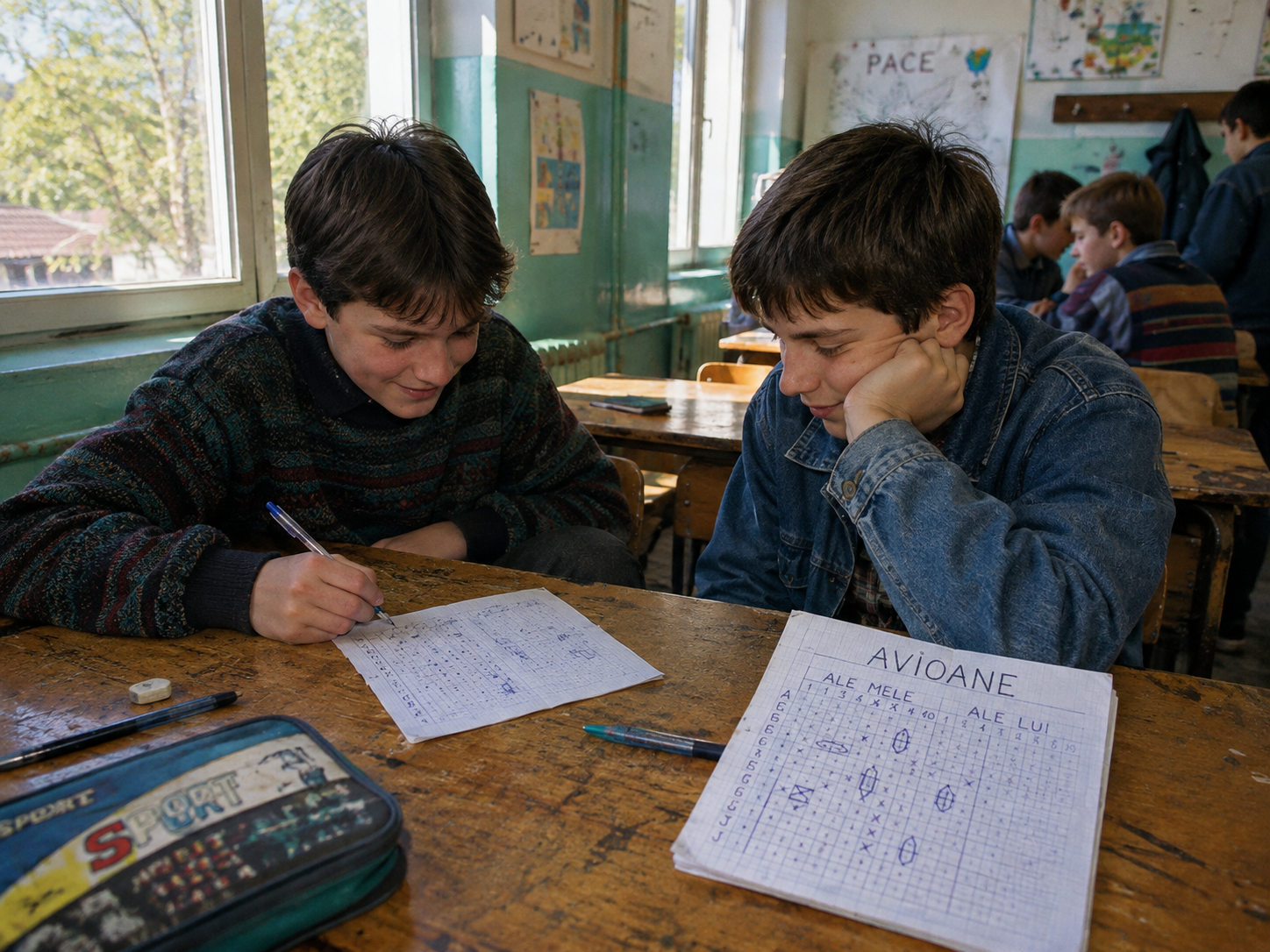
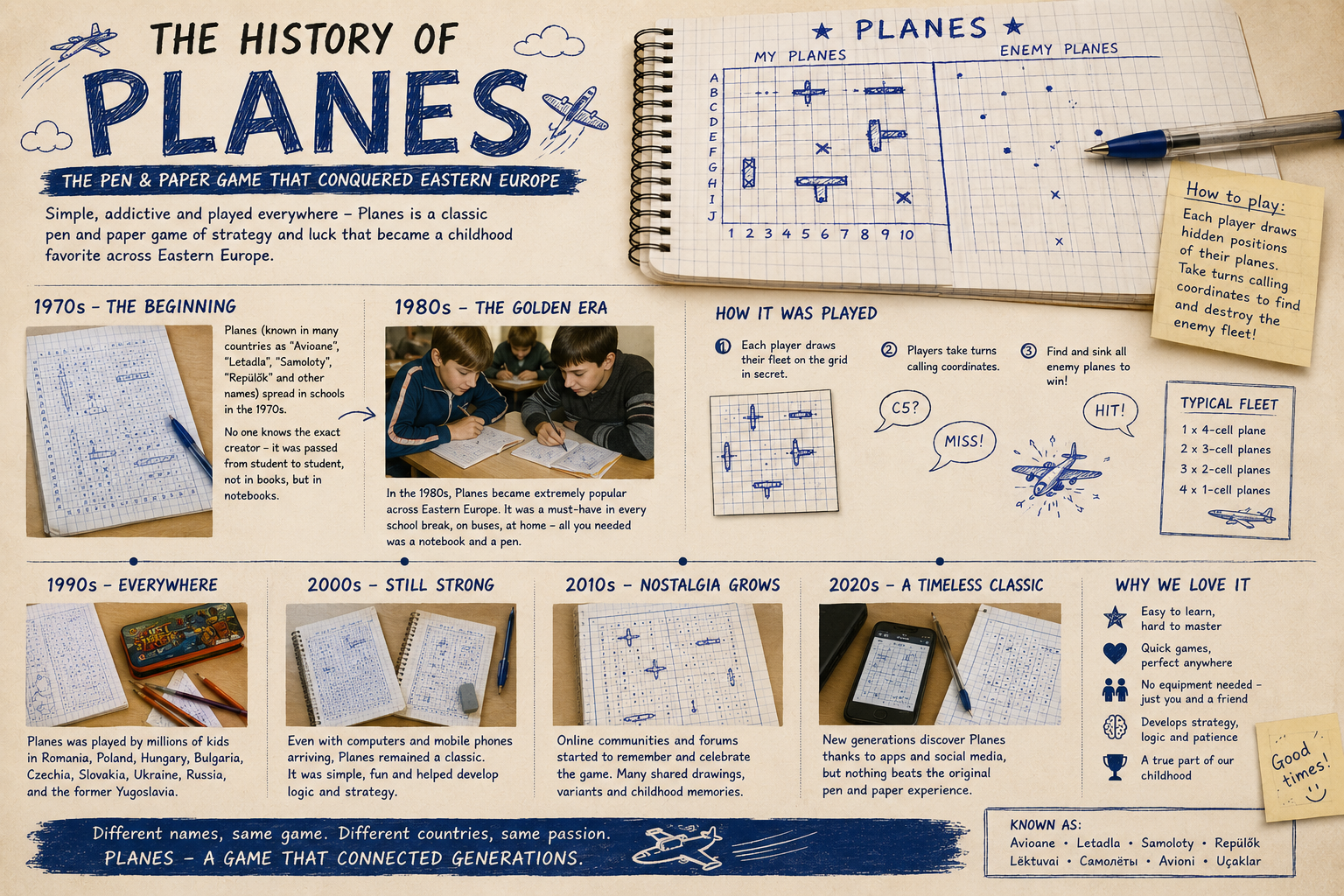
Although regional variants existed, the game became especially associated with Romania under names such as Avioane, where it developed a recognizable identity: each player secretly positioned airplane-shaped figures whose cockpit became the critical hit point. By the 1970s and 1980s, Planes was a familiar sight in schools, military service downtime, and office breaks, played on hand-drawn coordinate maps where memory, inference, and deception mattered more than luck. Oral transmission played a major role in rule stability, and many families passed down the same conventions for plane orientation, valid placements, and sudden-death victories when a cockpit was found.
How It Differed From Battleship
Planes is often compared with Battleship, but historically it evolved into a distinct logic style: in Battleship, players hunt linear ship segments, while in Planes, a single geometric silhouette must be reconstructed mentally from partial hits and misses. This meant expert players began treating each shot as information theory in practice, using probability maps, symmetry reduction, and elimination trees to infer possible cockpit coordinates. By the late 20th century, puzzle magazines and youth clubs in several countries were publishing Planes diagrams and challenge positions, proving the game had moved beyond casual guessing into a codified strategic pastime.
From Paper Notebooks to Early Software
As home computing expanded in the 1990s and 2000s, Planes transitioned into local computer implementations and web applets, preserving its hidden-placement mechanics while automating rule checks and turn tracking. These early digital versions helped standardize formats such as 10x10 boards and two or three planes per player, even though local house rules still survived. In educational settings, teachers and parents increasingly used Planes-like games to build spatial reasoning and deductive thinking, and cognitive training literature frequently grouped them with other pattern-detection exercises that improve working memory and strategic planning.
The Modern Logic-Game Legacy
Today, Planes remains a bridge between traditional tabletop culture and modern digital design: it is easy for beginners to learn in one round, yet rich enough for advanced players to develop opening systems, trap placements, and endgame deduction habits. Community tournaments, online matchmaking, and custom-rule mobile builds have kept the game alive, while fan communities continue debating optimal first-shot regions and statistically robust plane layouts. The enduring historical fact is clear: Planes survived because it combines three timeless attractions in one format, the creativity of hidden construction, the tension of uncertainty, and the intellectual satisfaction of solving an opponent's pattern under pressure.