A Puzzle Born in the 19th Century
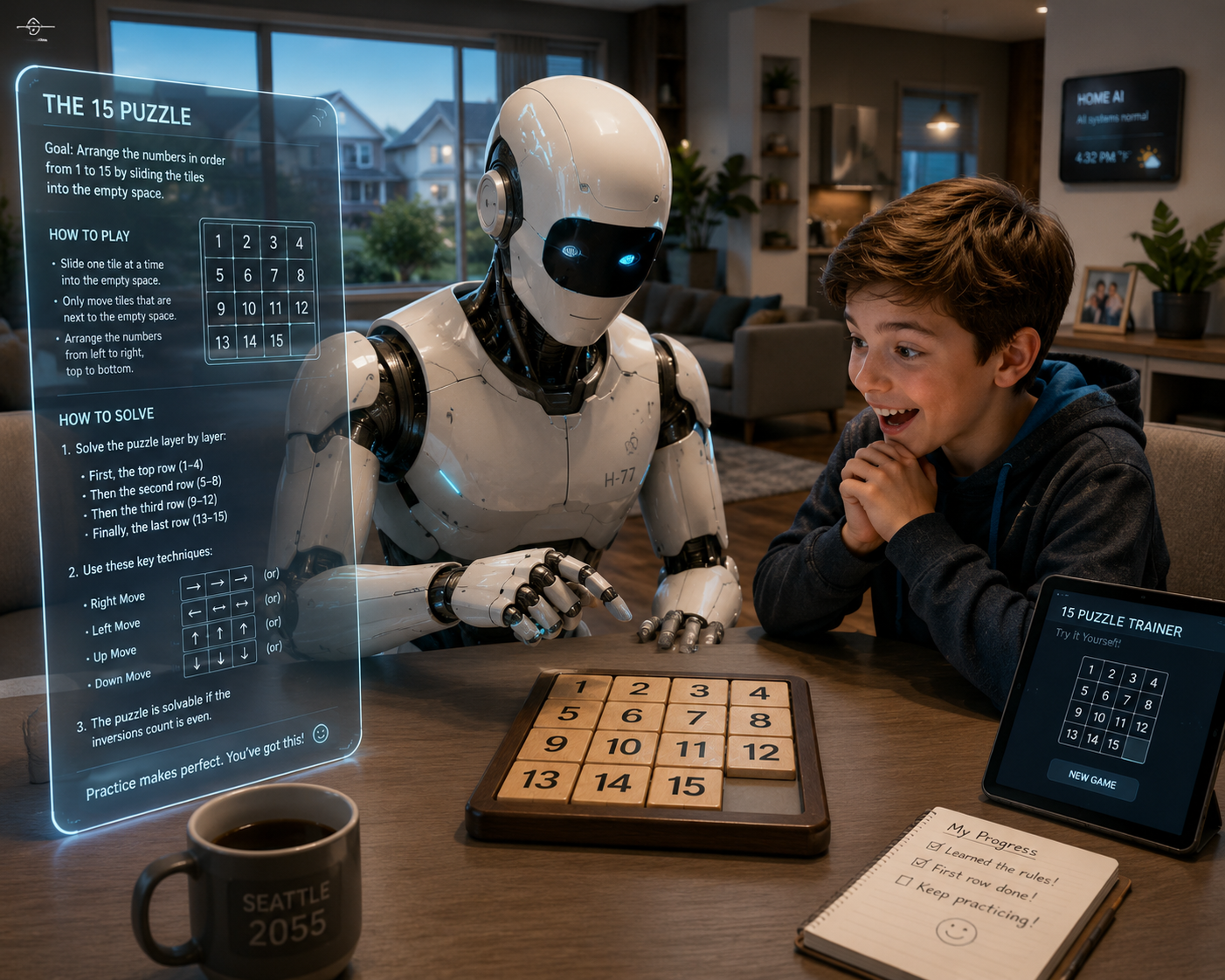
The 15 Puzzle emerged in the late 1800s, during a period when parlor puzzles and mechanical brain-teasers were becoming fashionable in Europe and the United States. The rules were easy to explain: arrange tiles numbered 1 through 15 on a 4x4 board using only sliding moves into one empty space. Despite that simplicity, certain arrangements proved surprisingly stubborn, turning the game into an instant social obsession.
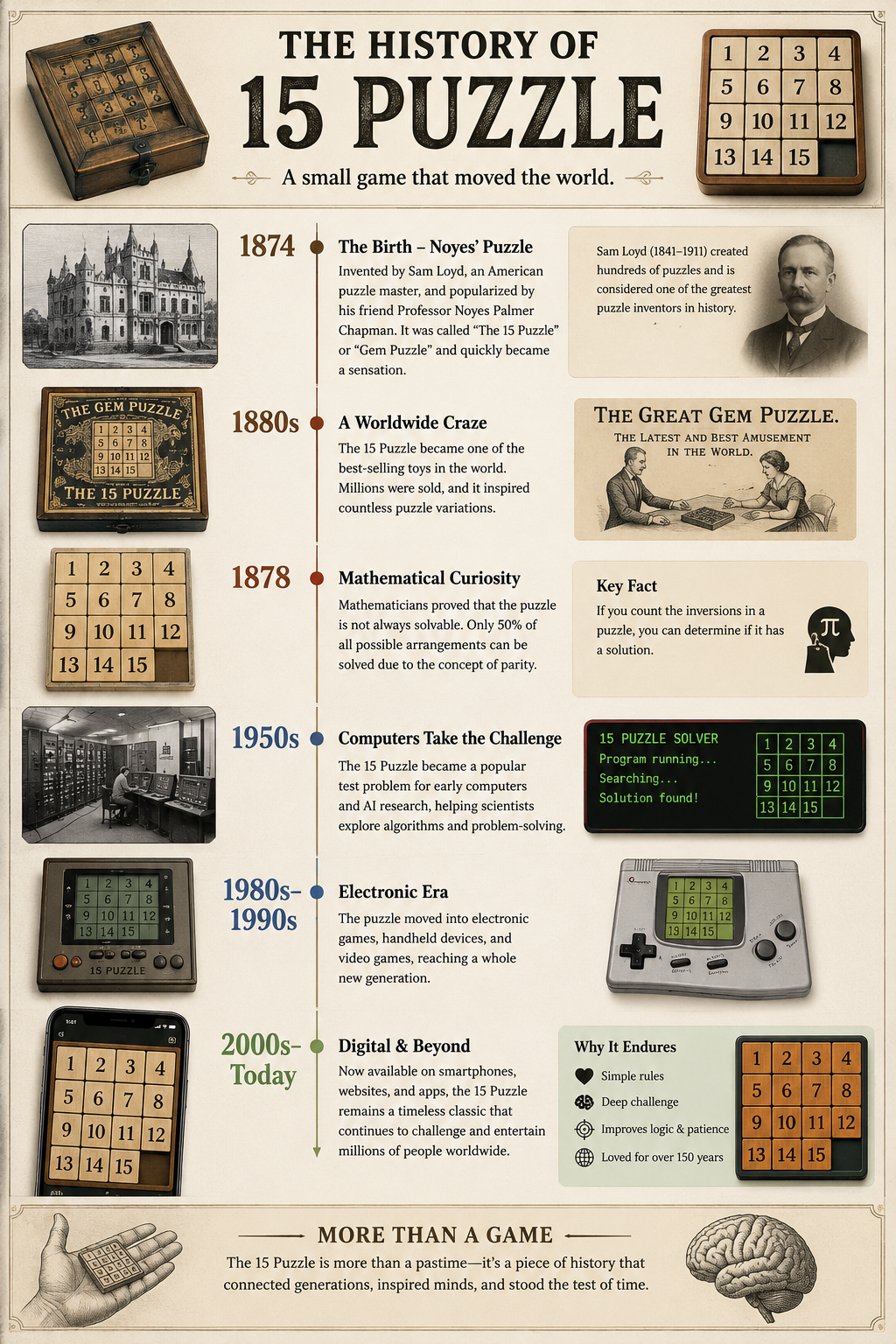
Several inventors and publishers were linked to early versions, and historical sources disagree on who deserves full credit. What is clear is that by the 1880s the puzzle had become recognizable in the same form we play today, with mass-produced sets sold as educational and recreational novelties.
The Great Puzzle Craze and the "14-15" Challenge
The 15 Puzzle exploded into mainstream attention through a famous variant now called the 14-15 challenge. In this configuration, every tile is in place except that tiles 14 and 15 are swapped. Newspapers and puzzle clubs offered prizes for solving it, and thousands of people spent long evenings trying to finish what looked like a nearly completed board.
The catch is that this position is impossible under legal slide moves. Mathematicians later explained why: tile permutations in the 15 Puzzle split into two classes, and a legal move sequence can never cross from one class to the other. This realization transformed a popular pastime into a classic lesson in parity and invariants.
From Toy to Mathematical Case Study
After the initial craze faded, the 15 Puzzle remained important in mathematics and logic education. It became a clean example for discussing state spaces, reachability, and algorithmic efficiency. In classrooms, it offered a hands-on way to teach abstract ideas: not every desired end state is reachable, and constraints can be invisible until you reason about them carefully.
By the 20th century, puzzle enthusiasts had also developed practical solving methods that balanced local tactics with global planning, the same thinking pattern used in many strategy games.
The 15 Puzzle in Computer Science
As computing grew, the 15 Puzzle became a benchmark problem for search algorithms. Researchers tested techniques like breadth-first search, A* search, and heuristic functions based on Manhattan distance to measure how quickly a machine could find optimal solutions. Because the rules are simple but the state space is large, the puzzle is ideal for studying tradeoffs between speed, memory, and solution quality.
In AI and robotics education, the puzzle is still used to illustrate core planning concepts. It sits at a useful midpoint: complex enough to be interesting, but structured enough to analyze rigorously.
Why It Still Matters
The 15 Puzzle endures because it feels timeless. It can be played physically or digitally, casually or competitively, by children discovering patterns or adults optimizing move counts. Every attempt trains visualization, sequencing, and patience.
More than a century after its rise, the puzzle remains a bridge between recreation and reasoning. It reminds us that even small systems can hide deep structure, and that elegant rules often produce the richest challenges.