Before Sudoku: The Mathematics of Latin Squares
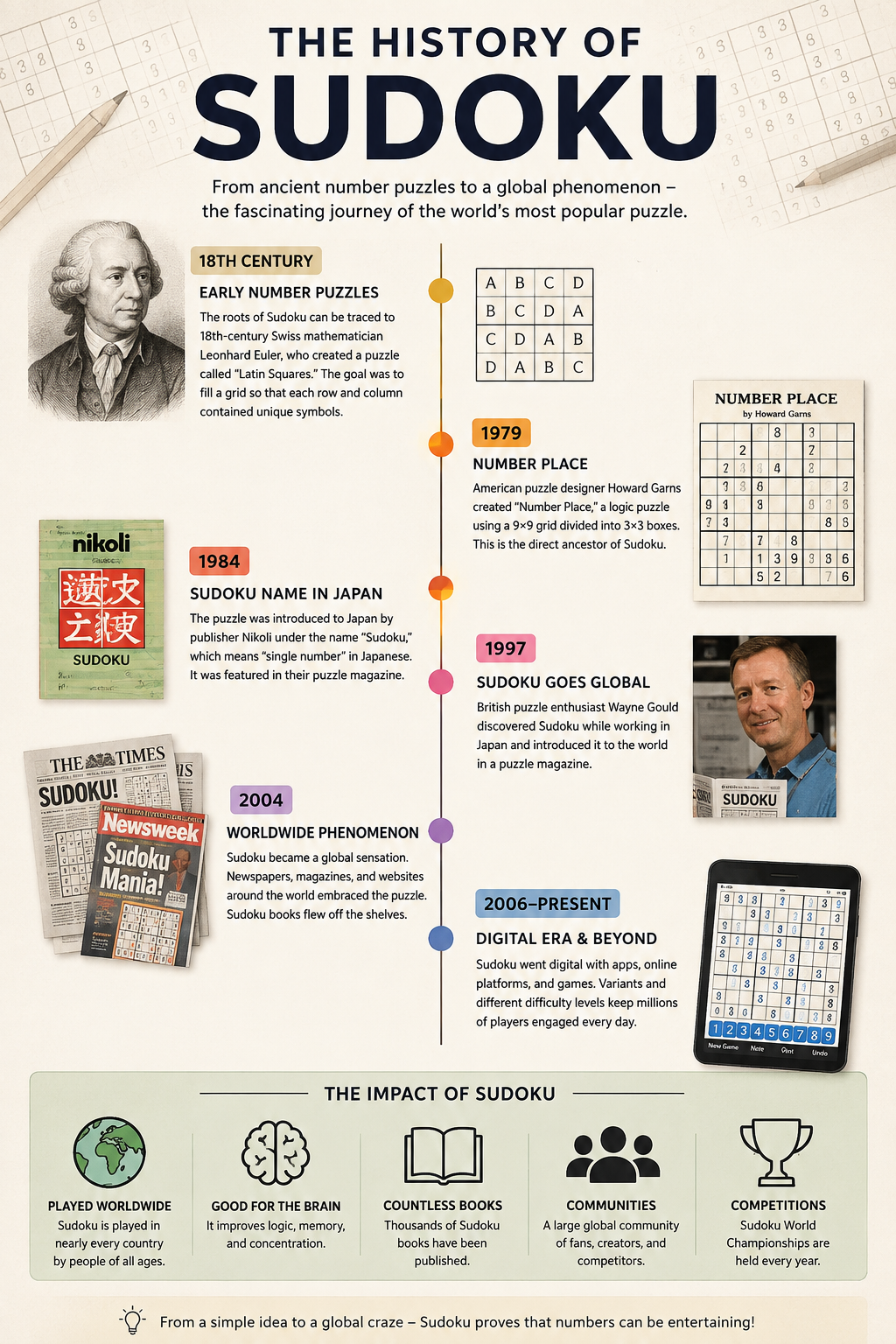
The roots of Sudoku begin in pure mathematics rather than in a traditional board game culture. In the 18th century, Swiss mathematician Leonhard Euler studied arrangements now known as Latin squares, where symbols appear exactly once in each row and each column. Euler was not inventing Sudoku itself, but his work introduced the structural idea at Sudoku's core: satisfying strict placement constraints across a grid.
For generations, these concepts lived mostly inside mathematical research and recreational logic circles. The jump from theory to popular puzzle required one more ingredient: a format that ordinary readers could solve quickly with pencil and paper.
The Newspaper Era in the Late 20th Century
A major milestone arrived in 1979, when a number-placement puzzle called Number Place appeared in Dell Pencil Puzzles and Word Games in the United States. The puzzle already looked familiar to modern players: a 9x9 grid divided into smaller boxes, with the solver filling in missing digits so each row, column, and box used 1 through 9 exactly once.
Number Place had elegant rules and no arithmetic requirements, which made it broadly accessible. You did not need advanced math, only logic, patience, and pattern recognition. Even so, the puzzle spread gradually at first rather than exploding overnight.
Japan and the Name Sudoku
The modern identity of the puzzle formed in Japan during the 1980s. Publisher Nikoli introduced the format to Japanese audiences and gave it the name Sudoku, short for a phrase meaning that digits must remain single or un-repeated. Nikoli also refined puzzle aesthetics and publishing standards, emphasizing carefully crafted clue patterns and a clean visual style.
Japanese editors and constructors helped define what many solvers now consider a high-quality puzzle: one with a unique solution and a logical path to completion without guesswork. These standards elevated Sudoku from a simple pastime into a respected design craft.
The Global Boom of the 2000s
Sudoku became a worldwide phenomenon in the mid-2000s. Newspapers across Europe, North America, and beyond began running daily grids, often receiving enthusiastic reader response. Books of Sudoku puzzles quickly climbed bestseller lists, and puzzle magazines expanded difficulty levels for beginners and experts alike.
Part of Sudoku's appeal was its universality. The symbols are digits, but language is almost irrelevant, so a puzzle can be enjoyed across cultures without translation. Commuters solved them on trains, students solved them between classes, and families solved them together at kitchen tables.
Digital Play, Competitive Solving, and Lasting Appeal
Smartphones and apps gave Sudoku a second life. Digital tools introduced hints, error checking, timers, and adaptive difficulty, making practice easier for new solvers and speed challenges more interesting for experts. Competitive communities also grew, including national championships and world-level puzzle events that reward both accuracy and rapid logical deduction.
Sudoku endures because it balances simplicity and complexity. The rules fit in a sentence, yet advanced solving can involve deep chains of inference and subtle pattern analysis. From Euler's abstract squares to today's mobile puzzle streaks, Sudoku's history shows how a clean idea can become a global habit of thought.